2 Marketers 1 Brand Presents: Zoho CRM

Every month, we ask people to nominate a brand. Then we pull it apart, live, on a webinar. No rehearsal. No slides approved by committee. Just two marketers, a screen share, and whatever we find when we start digging.
This month, the hive mind pointed us at Zoho CRM. So we fired up Hat GPT, John’s custom tool that analyses a website’s positioning, identifies ideal customer profiles, and scores product-market fit, and got to work.
Here’s what we found.
The competitive set
Zoho CRM sits in one of the most crowded categories in SaaS. Your direct competitors include HubSpot, Pipedrive, Salesforce, Monday CRM, and Airtable. That’s five alternatives a buyer could land on before they even get to you.
Hat GPT pulled each competitor’s homepage, brand assets, messaging, and positioning. We lined them up side by side.
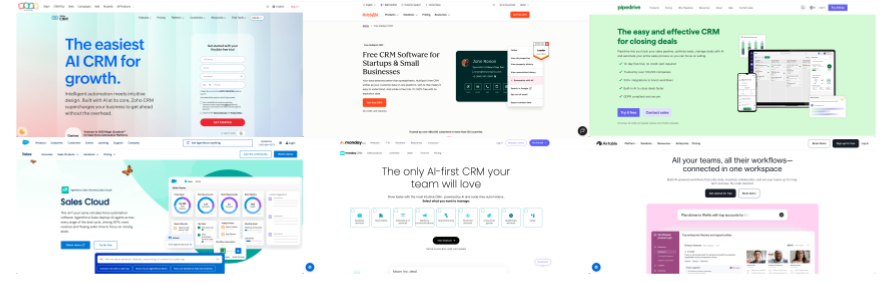
First impression: a sea of pastel. Normally when you get a group of competitors using similar colours, they’re all drab. Not here. They’re all fairly bright, which is unusual, and it suggests most of these companies are looking over the fence at each other.
Pipedrive’s mint green stood out as the least confrontational of the group. Salesforce felt like it was mid-rebrand, almost saying nothing, almost having no brand of its own. The rest blurred together.
If your homepage could belong to any of your competitors with a logo swap, you have a positioning problem.
Brand assets: logos and colour
We pulled the logos and colour palettes across all six.
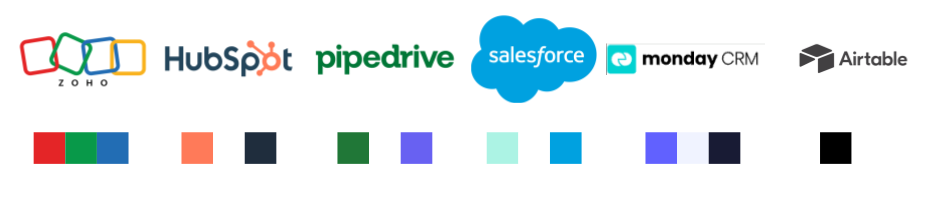
Zoho’s logo leans into an almost-Olympic palette: red, green, blue. None of those colours come across strongly enough to own. HubSpot has its coral. Pipedrive has its green. Salesforce has some middling light blues. Monday, despite a colourful parent brand logo, leads with a watered-down blue that looks like it’s borrowing from Salesforce. Airtable is essentially monotone.
HubSpot and Salesforce are the only two that are genuinely memorable here. Everyone else is fighting for fourth place.
Monday CRM is an interesting case. The parent brand, monday.com, has a far more distinctive logo and colour palette. For the CRM product, they’ve diluted that into something that could pass for a Salesforce sub-brand. If the goal is to ride someone else’s brand equity, it’s a strange way to do it.
The imagery problem
Most of these companies lead with screenshots of their own software on the homepage. We looked at two of them side by side and genuinely couldn’t tell which platform was which.
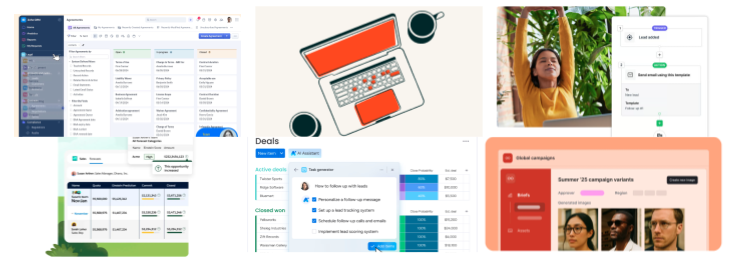
Salesforce is the exception, and the reason is simple: they have distinctive illustrations. The Einstein mascot, the Trailblazer characters, the entire visual universe they’ve built around their brand. Storm had only used Salesforce once, six or seven years ago, but immediately recognised the illustration style. That’s a distinctive asset doing its job years after the last interaction.
Nobody else in this competitive set is doing anything close to that. Screenshots of your own product are not brand assets. They’re furniture.
Same words, different logo
Hat GPT pulled the ten most-used words across all six websites.
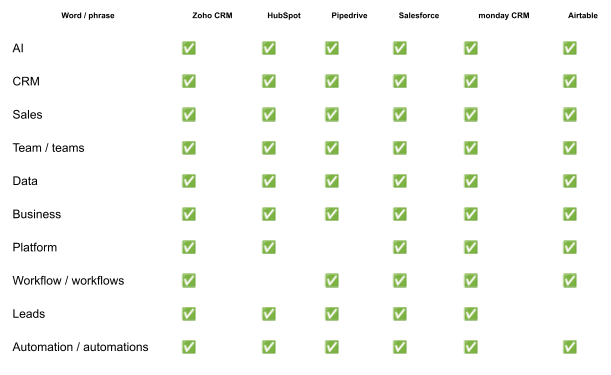
Zoho uses all of them. Every single one.
Words like AI, CRM, sales, team, workflows, platform. These are category terms, not brand terms. If all you’re doing is promoting the category, the only winner is the market leader. Every time Burger King talks generically about burgers, McDonald’s benefits. Same principle here. Every time Zoho or Pipedrive or Monday CRM pushes the concept of a “sales CRM” without saying anything distinctive about their own, Salesforce and HubSpot sweep up.
The research proves this. Category promotion feeds the category leader. Always.
The “we, we, we” problem
The we:you ratio, originally coined by Steve Harrison, the most awarded Cannes Lions creative director of all time, says the ideal ratio of talking about your customer versus talking about yourself is three to one.
The origin story is brilliant. As a young man, Harrison worked out that speaking three times more about the person he was hoping to go home with, and only once about himself, was the model that worked on a Friday night. It’s now part of how we analyse every brand we look at.
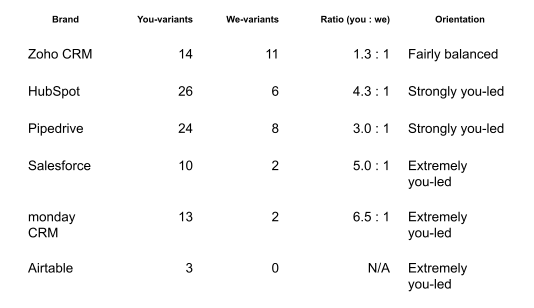
Across this competitive set, most of the big players get this roughly right. HubSpot, Salesforce, and Pipedrive all lean towards “you.” Airtable had three variants of “you” and zero mentions of “we,” which is almost unheard of.
Zoho? Out of whack. A ratio of 14 to 11, which is close to balanced but a long way from three to one. Whether that’s deliberate or accidental is the question. Storm’s suspicion: entirely accidental.
The fix costs nothing. Go through your website. Every time you’ve written “we do X,” rewrite it as “you get Y.” You’ll be shocked at how much warmer it reads.
Your tagline is the most valuable real estate you own
We pulled the taglines from all six.
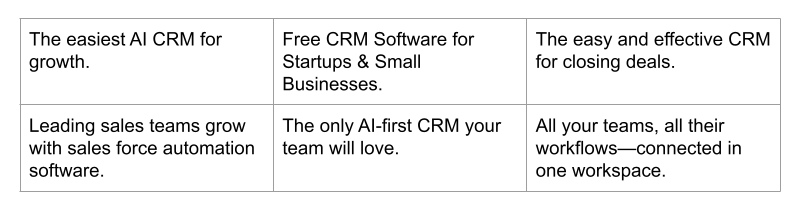
Zoho’s: “The easiest AI CRM for growth.”
It implies a few things. They’re clearly going after people who haven’t had a CRM before. That could be much sharper. “If you’ve never had a CRM, this is the one you should start with” already tells you more than “easiest AI CRM for growth” does.
“AI-powered” is not a benefit. Most buyers expect it. “For growth” is so vague it borders on meaningless. You’ll struggle to find a company that doesn’t want to grow. If they genuinely don’t want to grow, they’re probably the local hairdressers, and they’re not shopping for a CRM.
Monday CRM’s tagline, “the only AI-first CRM your team will love,” is the same proposition in different clothes. Does anyone love a CRM? We’ve both used Monday. Neither of us has ever logged on and thought, “I’m so lucky we get to use Monday right now.”
HubSpot’s, “free CRM software for startups and small businesses,” is the strongest of the group. It tells you who it’s for, what it does, and its price point in one line. That’s clarity. It’s rare.
If your tagline could be swapped onto a competitor’s homepage without anyone noticing, it isn’t doing its job.
Product-market fit: 74 out of 100
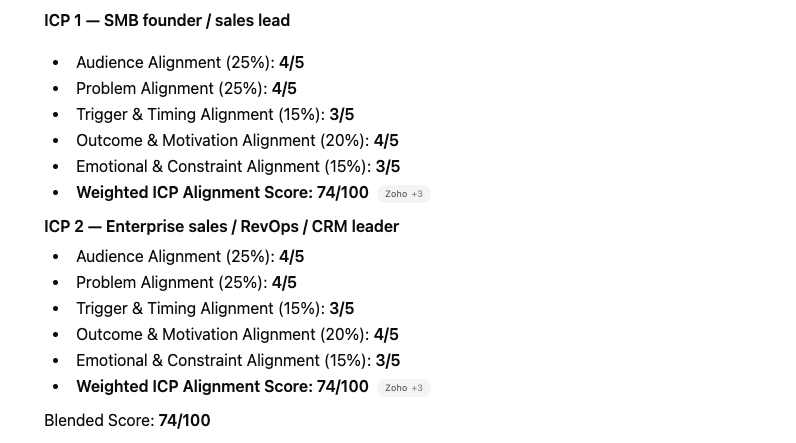
Hat GPT scored Zoho CRM at 74 out of 100 for product-market fit. High, but not great.
They scored fours across most categories. That’s unusual. Typically, you’d expect a five somewhere. The real weak spots were emotional alignment and trigger timing. The website doesn’t connect with how buyers feel when they’re making this decision, and it doesn’t catch them at the moment they’re ready to act.
This matters more than most companies realise. Research we’ve reviewed recently shows that B2B buyers are twice as emotionally invested in their purchases as B2C buyers. Nobody loses their job for having McDonald’s for lunch. Buy the wrong software platform for your company, and you might.
That emotional intensity should be an opportunity. Instead, the sameness across this category creates the opposite effect. Buyers can’t tell what makes one platform better than another, and roughly 86% of B2B buying decisions end in no decision at all. Not a no. Not “we went with someone else.” Just silence. People give up.
The Zoho problem
Zoho CRM is a sub-brand. The parent, Zoho, has its own website with a better tagline: “your life’s work, powered by our life’s work.” That’s got warmth. Commitment. Effort.
Then you scroll down and it says it’s “unique and powerful.” It’s not unique. “Designed for business of all sizes” means it’s designed for nobody in particular. “We value your company, your privacy” is table stakes, not a selling point.
The CRM product inherits none of the parent brand’s better instincts. It sits in, rather than standing out. The colour palette mirrors two of its competitors. The brand architecture is lazy: a secondary version of a not-remarkable brand.
Storm’s take: give me a day with Zoho and the first thing I’d do is strip out the competing hierarchy. Find a simple, easy-to-understand way into the product. You can’t tell me you’re for small businesses and then stick the Amazon and NHS logos on the same page. That’s not broad appeal. That’s a confused message.
What the power user actually remembers
John has used Zoho CRM extensively, and the two things he remembers most are ease of configuration and the quality of the reporting. When he was running a sales team, Zoho let him track where leads were coming from, which industries were converting, where the opportunities were going to be. It did a better job of that than HubSpot.
Neither of those things is mentioned anywhere on Zoho’s website.
If your best features are invisible to someone who’s never used the product, your homepage is failing. Show me how the CRM helps me manage my pipeline. Show me how it tells me which deals are warm and which are cold. If the AI is genuinely useful, show me what it does. Can I ask it to surface my top priority leads by revenue? That would be a hell of a feature. But you shouldn’t have to sign up and use the product to find out.
The emotional gap
Here’s the deeper issue. The literature shows that the more distinctive you are, the less people perceive you as a risk. Sameness doesn’t reduce risk. It increases it, because buyers can’t tell what part of your platform is better than anyone else’s.
The advice to Zoho, if they’re listening: grow a pair.
If you’re dedicated to being easy to use and being people’s first CRM, own that market. You can do it without going toe to toe with HubSpot on email marketing and social media management. Zoho doesn’t need to compete in that arena. But it does need to be bold about who it’s for and what it can do for them.
Professional services firms are a good example. A lot of them win new business based on luck and introductions. They don’t really do structured new business development. If that’s your target market, show them how a CRM can help them think about new business properly. Nobody else is doing that.
Why HubSpot keeps winning
HubSpot’s dominance isn’t complicated. They made it free. They made it easy. They got in early.
Storm’s experience is typical. HubSpot got in early enough in his career that every time he moved to a new company and needed a CRM, he already knew HubSpot. He knew who to call. He’d already done the training. Learning anything else seemed like a pain in the arse.
That’s not loyalty. That’s lock-in by friction removal. And it’s incredibly effective.
Combine that with a community-building strategy that was genuinely ahead of its time, a mountain of content that draws in people who don’t know any better, and a free tier that hooks you before you realise you’re paying. Competing with that on features alone is a losing game.
Which is exactly why competing on positioning matters.
A quick aside on brand confusion
During the session, John mentioned that when he tried to sign up for Claude, the AI tool, he ended up on the wrong platform entirely. A competitor is bidding aggressively on Claude’s keywords with ads that look close enough to the real thing.
Storm searched it live. The sponsored result for “Claude” on Google is a company called Chat On AI. They’ve titled their ad “Claude AI.” Click through and it calls itself “Claude Model.”
That’s beyond passing off. That’s the kind of thing that should have lawyers involved. But it’s a useful illustration of what happens when your brand equity isn’t strong enough to protect you. If a buyer can accidentally end up with your competitor and not immediately realise, your distinctive assets aren’t distinctive enough.
The observations above are free. The recommendations below are why you're here. They're also free — but we'd like your email address first.
So, where does this leave Zoho?
Not doing a terrible job. But not doing nearly as much as it could.
The product-market fit is there. The ease of use is apparently there. The reporting, if it’s still as good as John remembers, is a genuine differentiator.
None of that is visible from the outside.
The brand is undistinctive. The messaging promotes the category instead of the product. The tagline is interchangeable with at least two competitors. The website speaks to everyone, which means it speaks to nobody. And the emotional connection that B2B buyers are desperately looking for, whether they know it or not, is completely absent.
Storm’s suspicion is that Zoho is at the point where it’s too big to fail. That’s a luxury. But for the people watching this who don’t have that luxury, the lesson is straightforward.
Your buyers don’t give up because your product is bad. They give up because they can’t tell why yours is different. Fix that, and everything else gets easier.
Everything else is just flooring solutions.
Two Marketers, One Brand is a live series where John Lyons and Storm Mackay pull apart a real brand and show what trained positioning experts would do differently. Want your brand on the table next time? Get in touch.